
Introduction
On April 16, 2025, the Delhi High Court in its ruling in “Grey Swift Private Limited Through Mr. Shivam Singla v. Registrar of Trade Marks” emphasized on the holistic evaluation of a mark considered for registration and laid stress on the protection of innovatively coined trademarks. As per Section 9(1) of the Trade Marks Act, 1999 (hereinafter ‘Act’), the marks that are “devoid of any distinctive character” and “not capable of distinguishing the goods or services of one person from those of another person” cannot be registered under the trademark law in India.
In this article, the author analyses the Hon’ble High Court’s decision by examining the various aspects related to the distinctiveness in the Act, along with perusing various judicial precedents related to the interpretation of trademark distinctiveness. Moreover, the author analyses the need to create an equilibrium between maintaining a trademark’s distinctiveness and providing legal protection to innovative composite marks. The author also brings forth certain suggestions to help the trademark applicants ensure the fulfilment of trademark distinctiveness standards for their registrations.
BharatStamp’s Struggle for Trademark Registration
On February 20, 2021, Grey Swift (hereinafter ‘Appellant’) applied for the Trademark registration of their mark “BharatStamp” in Class 9 of the Act on a “proposed to be used” basis. The Registrar of Trademarks (hereinafter ‘Respondent’) raised an objection under Section 9(1)(a) of the Act stating that “the mark is non-distinctive and as such it is not capable of distinguishing the goods of one person from the others”. The Respondent passed an order that the Appellant’s mark can’t be registered as per Section 9(1) of the Act and thus, the Appellant’s application was rejected because of the reason stated as above.
Disgruntled by the order, the Appellant filed an appeal before the Delhi High Court, which allowed the appeal and set aside the impugned order passed by the Trademark Registry. It observed that although the mark “Bharatstamp” comprises two commonly used words, it is a coined term. The court emphasized that the mark must be assessed in its entirety and not dissected into its individual components. Moreover, the court also took note of the inconsistent approach of the Respondent in granting registration to similar marks such as BharatPe, Bharat Vision, and BharatSign. On the basis of this reasoning, the court held that the mark ‘Bharatstamp’ is inherently distinctive and thus capable of registration.
The Concept of Distinctiveness in Trademark Law
Section 9 of the Act lays down the “Absolute grounds for refusal of registration”. The first ground of this Section states that:
“(1) The trademarks–
(a) which are devoid of any distinctive character, that is to say, not capable of distinguishing the goods or services of one person from those of another person;”
Thus, emphasizing that a trademark has to be capable of distinguishing the goods or services of one person from those of another person and have the ability to act as a source identifier to get registered under the Act.
The Indian judiciary recognizes that a mark has to be distinctive to qualify for trademark registration, as highlighted in its judgements, such as M/S.Heinz Italia & Anr vs M/S.Dabur India Ltd (wherein an interim injunction was issued to Dabur India, restraining it from using the word “Glucon-D”) and Sky Enterprise Private Ltd. vs. Abaad Masala and Co. (wherein an interim injunction was issued to Abaad Masala from using their deceptively similar trademarks).
Furthermore, the Delhi High Court in the case of Disruptive Health Solutions Private Limited vs Registrar of Trade Marks, underscored the gamut of distinctiveness by laying down the criterion on which distinctiveness is to be judged. To determine the distinctiveness of a mark for its registration, it has to be taken as a whole. Through various precedents, such as Ticona Polymers, Inc. v. Registrar of Trade Marks, Mikko Vault LLC v. Registrar of Trade Marks and Global Super Parts v. Blue Super Flame Industries, the Courts have upheld the law that the registrability of a trademark must be assessed in its entirety.
Moreover, Section 32 of the Act is an exception to Section 9(1) of the Act specifying that if a trademark “has after registration and before commencement of any legal proceedings challenging the validity of such registration, acquired a distinctive character in relation to the goods or services for which it is registered” then it cannot be declared void on the ground mentioned in Section 9(1).
Analysis of the BharatStamp Judgement
Justice Banerjee, while analyzing the case, relied on the judgement of the Hon’ble Supreme Court in the case of F. Hoffmann-La Roche & Co. Ltd. v. Geoffrey Manners & Co. Pvt. Ltd., wherein a similar dispute arose. The Court noted that although the word “Dropovit” was formulated from two common English words, the newly devised word is unique and capable of registration. The author is in consonance with the Hon’ble Justice’s view and believes that although the mark “BharatStamp” is devised out of common English words, it is a composite mark and is not generic in nature and thus, distinctive and capable of registration. The counterargument advanced by the Respondent that the use of commonly known words such as “Bharat” and “Stamp” renders the mark non-distinctive, here fails to consider the principle of holistic assessment under trademark law. The Court rightly held that a mark should not be anatomized in its individual parts while considering it for registration. It further observed that the Respondent has previously allowed the registration of similar ‘word’ and ‘device’ marks, such as BharatPe, Bharat ScanPay, BHARAT VISION, BHARAT ELECTRONICS and many others. Thus, in the author’s opinion, the Hon’ble Court has rightfully recognized the capability of the mark ‘BharatStamp’ for registration. However, the Appellant cannot claim exclusive rights over any individual parts of the mark.
Suggestions
It is of crucial importance for a business to select an appropriate mark that is creative, idiosyncratic and can be easily retained in the memory of the customers, as also suggested by the INTA Fact Sheet: Selecting and Registering a Trademark- Considerations in Selecting a Trademark. Thus, the trademark applicants should not opt for common or descriptive words as they can be subjected to the provisions of Section 9 of the Act and thus will remain prone to potential objections or refusals. The applicant should rather choose a mark that is novel and has an unusual juxtaposition. Before choosing a mark, the applicant should focus on analyzing its strength by looking at the “Abercrombie spectrum”, given by Judge Friendly in the landmark case of Abercrombie & Fitch. This spectrum is recognized worldwide and by various international organizations such as the International Trademark Association.
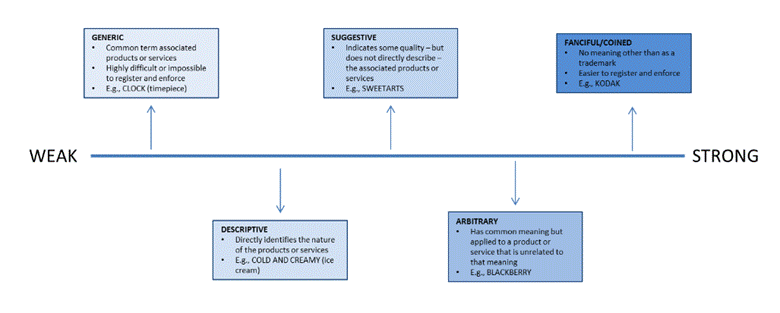
Credit: International Trademark Association
Thus, the trademark applicants should carefully choose a distinctive trademark after analyzing this spectrum, as this will allow them to choose a stronger trademark that can be protected and legally enforced.
Conclusion
The use of descriptive or similar words can create confusion in the minds of customers. The Indian Trademark Act recognizes this principle and does not allow the registration of such marks. However, as highlighted in the present ruling of the Delhi High Court, it is equally important that the registrability of a trademark must be assessed in its entirety. The criterion to determine distinctiveness is continuously evolving. Thus, it becomes crucial that the appropriate authority should also consider the composite nature of the mark rather than examining its individual components/parts. Moreover, the case underscores the importance of strategic mark selection by trademark applicants in mitigating potential legal disputes. It serves as a reminder that thoughtful and informed choices at the stage of registration can safeguard businesses from prolonged litigation and strengthen the enforceability of their brand identity.
This blog is written by Anureet Kaur, 2nd Year student, Second Year BA LLB (Hons.) student at Rajiv Gandhi National University of Law, Punjab.
